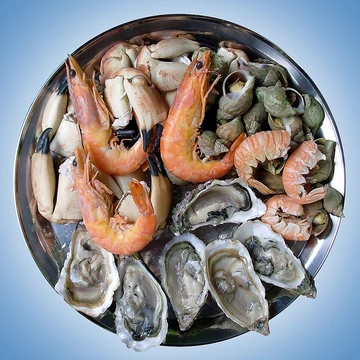
Clam
Edible bivalve molluscs that burrow in sand or mud.
Clam is a common name for several species of bivalve mollusc. The word is often applied only to those that are deemed edible and live as infauna, spending most of their lives halfway buried in the sand of the sea floor or riverbeds. Clams have two shells of equal size connected by two adductor muscles and have a powerful burrowing foot. They live in both freshwater and marine environments; in salt water they prefer to burrow down into the mud and the turbidity of the water required varies with species and location; the greatest diversity of these is in North America. Clams are shellfish that make up an important part of the web of life that keeps the seas functioning, both as filter feeders and as a food source for many different animals.
- field
- Bivalve mollusc
- known_for
- Edible infaunal bivalves, filter feeders, food source for many animals and humans
- habitat
- Freshwater and marine environments, burrowing in sand or mud
- lifespan
- Some have life cycles of only one year; at least one reached more than 500 years
- anatomy
- Two calcareous valves, hinge joint, ligament, adductor muscles, kidneys, heart, mouth, stomach, nervous system, many have a siphon
Lore & Background
Clams have two shells of equal size connected by two adductor muscles and a powerful burrowing foot. They live in both freshwater and marine environments; in salt water they prefer to burrow down into the mud. The greatest diversity of clams is in North America. Some clams have life cycles of only one year, whilst at least one reached an age of more than 500 years. All clams have two calcareous shells or valves joined near a hinge with a flexible ligament and all are filter feeders. A clam's shell consists of two (usually equal) valves, which are connected by a hinge joint and a ligament that can be internal or external. The ligament provides tension to bring the valves apart, whilst one or two adductor muscles can contract to close the valves. Clams also have kidneys, a heart, a mouth, a stomach, and a nervous system. Many have a siphon.
Reader's Guide
Clams are an important part of the web of life that keeps the seas functioning, both as filter feeders and as a food source for many different animals. Extant mammals that eat clams include both the Pacific and Atlantic species of walrus, all known subspecies of harbour seals, most species of sea lions, bearded seals and even species of river otters. Birds of all kinds will also eat clams if they can catch them in the littoral zone, including roseate spoonbills, Eurasian oystercatcher, whooping crane, common crane, American flamingo, and common sandpiper. Most species of octopus have clams as a staple of their diet, up to and including the Giant Pacific octopus. Cultures around the world eat clams along with many other types of shellfish. In North America, clams are used in clam chowder, clams casino, clam cakes, stuffies, and New England clam bakes. In Asia, clams are used in curries, fried dishes, hot pot, miso soup, and tsukudani. In Europe, clams are often an ingredient of mixed seafood dishes or eaten with pasta. Some species of clam were used by the Algonquians of Eastern North America to manufacture wampum and to make shell money.
Did You Know?
- Clams have two shells of equal size connected by two adductor muscles and have a powerful burrowing foot.
- Some clams have life cycles of only one year, whilst at least one reached an age of more than 500 years.
- In Judaism, clams are not kosher; in Islam, clams are considered halal in three Sunni madhhabs, but not in Hanafi.
- Some species of clam, particularly Mercenaria mercenaria, were used by the Algonquians to manufacture wampum and shell money.
Frequently Asked Questions
What is a clam?
A clam is a common name for edible bivalve molluscs that spend most of their existence partially buried in sandy or muddy substrates. They are filter-feeding shellfish found in both saltwater and freshwater habitats.
How do clams live in their environment?
Clams are infaunal organisms that use a powerful muscular foot to burrow halfway into the sand or mud of sea floors and riverbeds. They draw in water through siphons to filter-feed, and the turbidity they prefer varies by species and location.
What does a clam's anatomy include?
A clam is enclosed in two equal-sized calcareous shells joined by a hinge joint and ligament, with two adductor muscles connecting the valves. Internally it possesses a heart, kidneys, stomach, mouth, nervous system, and often a siphon for water intake.
How long can a clam live?
Lifespan among clam species ranges enormously—from individuals that complete an entire life cycle in just one year to at least one documented specimen that exceeded 500 years of age.
Where are clams most diverse?
Clams inhabit both marine and freshwater ecosystems around the world, but the highest concentration of species diversity is found in North America. In saltwater they favor burrowing into mud, while freshwater species settle into riverbeds.
Spotted an error? Know more?
This is a living reference — every entry is fact-audited, and reader corrections feed straight into our audit queue. Suggest an edit · See this site's audit record