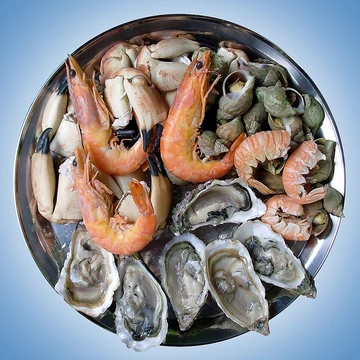
Shrimp
Swimming crustaceans vital to ecosystems and global fisheries.
Shrimp are common names for crustaceans with elongated bodies and a primarily swimming mode of locomotion, typically referring to decapods of the Caridea or Dendrobranchiata. They are widespread and abundant, found in both freshwater and marine habitats, and play important roles in the food chain as a food source for larger animals. Commercially, shrimp are among the most popular shellfish, with their muscular tails widely caught or farmed for human consumption, supporting a multi-billion-dollar industry.
- field
- Crustacean biology
- known_for
- Being a widely consumed shellfish; supporting a 50-billion-dollar industry; commercial production reaching nearly 7 million tonnes in 2010
- habitat
- Freshwater and marine environments worldwide
- lifespan
- One to seven years
- taxonomic_notes
- Terms shrimp and prawn are common names, not scientific taxa; usage varies by region
Lore & Background
The term shrimp originated around the 14th century from Middle English shrimpe, meaning 'to contract or wrinkle', and is associated with smallness, though some species exceed 25 cm. The terms shrimp and prawn are vernacular, not scientific, and their usage is often confused or reversed in different countries. Larger commercially fished species are generally called shrimp in the United States and prawns in other English-speaking countries, but no clear taxonomic distinction exists.
Shrimp are swimming crustaceans with long narrow muscular abdomens and long antennae, adapted for swimming rather than walking. They swim forward by paddling swimmerets, but escape by flicking their tails backward. Their thin, fragile legs are used primarily for perching, unlike the strong walking legs of crabs and lobsters. The earliest shrimp fossils date from the Lower Jurassic, with only 57 exclusively fossil species known.
Shrimp farming became more prevalent during the 1980s, particularly in China, and by 2007 harvest from farms exceeded wild capture. Excessive bycatch and overfishing from wild shrimperies are significant concerns, and waterbodies may suffer from pollution used to support shrimp farming.
Reader's Guide
Shrimp hold significance as both ecological keystones and economic commodities. They are widespread and abundant, inhabiting diverse freshwater and marine environments, and serve as crucial links in food chains, being prey for fish, whales, and other animals. Their commercial importance is immense: the shrimp industry is worth 50 billion dollars annually, with nearly 7 million tonnes produced in 2010. The rise of shrimp farming, especially in China from the 1980s, shifted production from wild capture to aquaculture, but this has introduced environmental challenges such as pollution and bycatch. The terminology surrounding shrimp and prawn remains ambiguous, reflecting regional and historical usage rather than scientific classification. This ambiguity, combined with the oxymoronic phrase 'jumbo shrimp', highlights the cultural and linguistic complexity of these crustaceans. Understanding shrimp's role in ecosystems and global trade underscores the need for sustainable practices to balance human consumption with environmental health.
Did You Know?
- The term shrimp originated around the 14th century from Middle English shrimpe, meaning 'to contract or wrinkle'.
- Shrimp typically live from one to seven years.
- The earliest shrimp fossils date from the Lower Jurassic.
- By 2007, harvest from shrimp farms exceeded the capture of wild shrimp.
Frequently Asked Questions
What exactly is a shrimp?
A shrimp is a small, elongated-body crustacean that gets around mainly by swimming, belonging to decapod groups such as Caridea or Dendrobranchiata. They are widespread in both saltwater and freshwater and serve as a key food source for larger aquatic animals.
What's the difference between shrimp and prawn?
The words "shrimp" and "prawn" are common names rather than formal scientific taxa, so which one you use often depends on your region. Neither term pins down a single biological group, making the distinction more cultural than taxonomic.
Where do shrimp live in the wild?
Shrimp occupy both freshwater and marine habitats around the entire globe, making them one of the most geographically widespread crustacean groups. Their abundance in diverse water bodies also cements their role as a foundational link in aquatic food chains.
How long do shrimp live?
Depending on the species, a shrimp's lifespan ranges from about one to seven years. That relatively short life cycle helps them reproduce quickly, which is part of why they stay so plentiful in both wild populations and aquaculture operations.
How big is the global shrimp industry?
Shrimp underpin a roughly 50-billion-dollar commercial sector, with total production reaching close to 7 million tonnes by 2010. Their muscular tails make them one of the most popular shellfish eaten worldwide, whether harvested from the wild or raised on farms.
Spotted an error? Know more?
This is a living reference — every entry is fact-audited, and reader corrections feed straight into our audit queue. Suggest an edit · See this site's audit record